April 2026 Newsletter
Federal Reform Is Already Shifting Investor Appetite
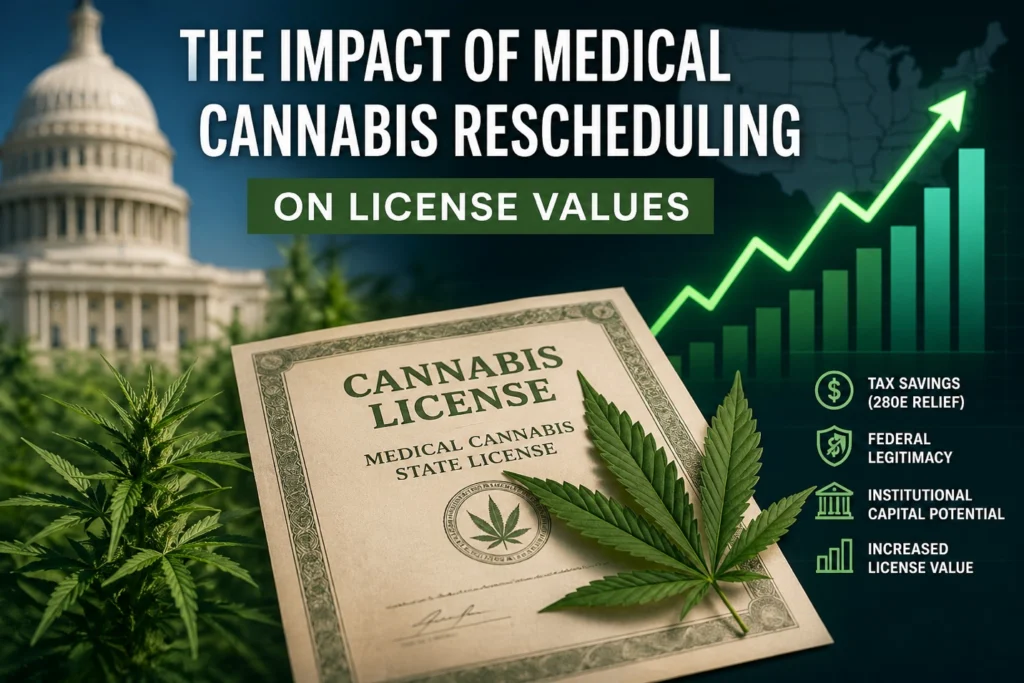
The DOJ’s move to reschedule state-licensed medical cannabis to Schedule III is the most meaningful federal shift the industry has seen in decades. In our latest blog, we break down how this change is already impacting the market. At CannaMLS, we’ve seen a surge in demand for medical-only licenses, driven by immediate 280E tax relief and improved economics for operators.
But what happens next could change everything.
With adult-use cannabis still classified as Schedule I (for now), the industry may be entering a two-channel system where medical operators gain a structural advantage, potentially driving higher valuations and attracting new capital. At the same time, upcoming federal hearings this summer could extend these benefits to the entire industry, reshaping capital flows across all cannabis assets.
Read the blog to understand how rescheduling could impact license values, investor behavior, and where the market is heading next.
Here Come the Canadians? Village Farms Could Be the First of Many Targeting U.S. Assets Post-Rescheduling
The recent federal rescheduling of medical cannabis to Schedule III is already sending signals beyond U.S. operators, and international players are paying attention. Canadian cannabis company Village Farms wasted no time responding. In its April 23, 2026 press release, the company stated it “looks forward to the opportunity to activate its U.S. assets once permissible by all regulatory authorities” following the rescheduling decision.
This isn’t just commentary, it’s positioning. Village Farms already controls significant U.S. greenhouse infrastructure, and like many international operators, it has been waiting on federal clarity before deploying capital. Rescheduling, while limited to medical for now, introduces something new: a pathway to federally recognized participation in the U.S. cannabis supply chain. Even without full legalization, this shift reduces regulatory risk perception, signals long-term federal acceptance of medical cannabis, and creates a framework for future commercial activation.
Importantly, Village Farms is unlikely to be alone. If rescheduling expands to include adult-use cannabis later this year, we expect increased cross-border M&A, strategic investments in U.S. cultivation and distribution, and new institutional capital entering the market. If it does not, medical-only pathways may still attract international operators seeking tax advantages, regulatory clarity, and early positioning.
Bottom line:
Rescheduling isn’t just impacting U.S. license values; it may mark the beginning of global capital targeting U.S. cannabis assets.
Massachusetts Market Reset: Supply Tightening and Retail Expansion Could Drive Valuations Higher
Recent regulatory changes are addressing both sides of the supply-demand imbalance. On the supply side, the Cannabis Control Commission has approved a four-month moratorium on new cultivation licenses, aiming to stabilize wholesale pricing after years of oversupply, which has driven prices down significantly since 2018.
At the same time, the state is expanding revenue potential for operators. The retail license cap has doubled from three to six locations, allowing operators to scale more efficiently, spread overhead across a larger footprint, and capture greater market share.
Additional tailwinds, including statewide delivery expansion, increased possession limits, and the introduction of consumption lounges, are expected to further support demand growth. Together, these changes signal a structural shift: reduced supply pressure, improved retail economics, and greater operator scale.
Massachusetts is quietly implementing one of the most meaningful market corrections in the U.S. cannabis industry that could materially improve business valuations.
New Jersey Launches Low-Cost Cannabis Loan Program
New Jersey is taking a meaningful step to address one of the industry’s biggest challenges: access to affordable capital. The state’s Economic Development Authority has officially launched the NJ LEAF program (New Jersey Lending for Equity, Access, and Financing), a $15 million initiative designed to support small cannabis operators across the supply chain. The program provides:
- $100K to $1.5M for real estate and equipment
- $100K to $500K for working capital
Interest rates are tied to U.S. Treasury benchmarks (with a 1% floor), plus a modest spread based on credit risk and loan term, offering significantly lower borrowing costs than typical cannabis financing. Eligible businesses must be New Jersey-based, hold a valid cultivation, manufacturing, or testing license, and have under 250 employees and less than $5 million in annual revenue. Importantly, this program is targeted at smaller operators who remain largely shut out of traditional financing channels.
This initiative reflects a broader trend: states stepping in to fill the capital gap while federal banking reform remains unresolved. Cannabis businesses continue to face high borrowing costs and limited access to credit, making programs like NJ LEAF increasingly important.
Missouri Hemp Crackdown to Drive More Demand to Licensed Cannabis Operators
This month, Governor Mike Parson signed legislation banning the sale of intoxicating hemp-derived products (including delta-8 THC) outside of the state’s regulated cannabis system. Under the new law, these products will no longer be sold in gas stations, smoke shops, or convenience stores, and will instead be restricted to licensed dispensaries beginning in November 2026.
For years, hemp-derived THC products have operated in a gray market, competing directly with regulated cannabis without the same testing, taxation, or compliance requirements. This shift effectively eliminates a major unlicensed sales channel, pushing consumer demand back into the regulated system.
Missouri’s crackdown is a clear example of states tightening control over intoxicating products, creating a more level playing field for licensed operators and reinforcing the long-term strength of cannabis dispensaries.
New Feature Announcement
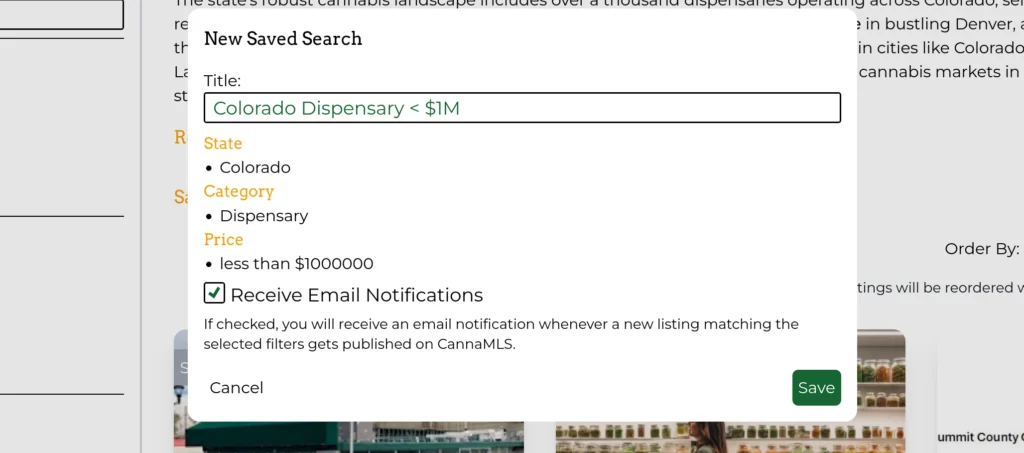
New on CannaMLS: Saved Searches + Real-Time Listing Alerts
The best deals get taken quickly. If you’re not seeing opportunities the moment they hit the market, you’re already behind.
That’s why we just launched Saved Searches + Listing Alerts on CannaMLS.
You can now lock in your exact acquisition criteria and get notified immediately when new listings go live that match what you’re looking for.
How it works:
- Run a search using your preferred filters (state, license type, price, etc.)
- Click “Save this Search”
- Turn on email alerts
From there, CannaMLS works for you, tracking the market 24/7 and delivering relevant opportunities directly to your inbox. Even better: you can save searches before inventory even exists, so you’re first in line when new listings go live.
If you’re expanding into new markets or just monitoring the competition, this is the simplest way to make sure you see every deal first.