August 2026 Newsletter
What the Industry's Biggest Lenders Told Investors This Quarter
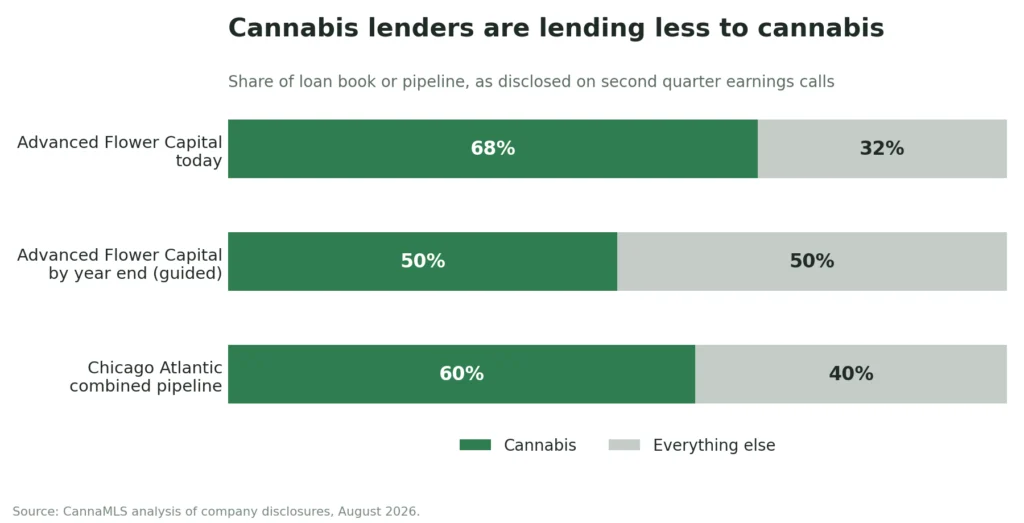
Cannabis's largest lenders reported second quarter results and hosted earnings calls this month. Two themes came through clearly: the lenders are steadily moving capital outside cannabis, and they are done extending lifelines to borrowers who cannot pay.
Advanced Flower Capital (AFCG) told investors that roughly a third of its loan book by fair value now sits in non-cannabis commercial lending, including a behavioral health roll-up in New England, and management signaled that share could approach half by year end. Chicago Atlantic is going a different route to the same place: its business development company (LIEN) and its real estate finance arm (REFI) confirmed their merger is on track to close in the fourth quarter, creating a single platform with a combined book expected to top $800 million and a pipeline running roughly 60% cannabis and 40% other lower middle market lending.
The collections picture came almost entirely from Advanced Flower Capital, which walked through three defaulted positions. Two of three Massachusetts dispensaries backing its DMA Holdings loan sold through a receiver in July, at a valuation of roughly a third of what an average store in that state generates annually. Term sheets are signed on two Arizona cultivation assets tied to its Devi Holdings loan for $12.5 million in cash, with a non-refundable deposit already paid. And its largest problem loan, to Justice Grown, went into default in May; AFC is pursuing public sales of the collateral under UCC Article 9, covering vertical assets in New Jersey and three dispensaries plus a non-operational facility in Pennsylvania. A hearing is set for September 15, with the Pennsylvania sale currently scheduled for September 24 and New Jersey for October 6.
It is not all foreclosure. Chicago Atlantic Real Estate Finance (REFI) described the other path on its call: rather than seizing assets on a Pennsylvania loan that had gone non-performing, it worked with a new, better-capitalized sponsor, restructured the debt, and financed the acquisition of additional stores to strengthen the business. It returned to performing status. REFI also amended an Illinois loan to a paid-in-kind interest structure to keep it current instead of forcing a default.
For buyers and sellers, the read is the same either way. Traditional senior debt is harder to secure than it has been in years, quality assets are about to hit the market through foreclosure at steep discounts, and more deals are getting done with seller notes, earn-outs, and sale-leasebacks than with bank financing.
The Rent Reality Check: Above-Market Leases Are Breaking Mature Markets
In the early years of any state market, operators accepted a cannabis premium on rent, often two to three times the going commercial rate. With tight municipal zoning, capped retail licenses, and opening-year margins, the trade looked rational.
Mature markets have flipped that math. In California, Colorado, Michigan, and Massachusetts, price compression has turned yesterday's manageable lease into today's fixed-cost trap. Buyers have noticed. Rather than valuing a business purely as a multiple of earnings, they are increasingly underwriting whether the location can survive a realistic downside case with the rent it is committed to. If it cannot, the lease gets treated as a liability rather than a line item, and the deal stalls after the LOI.
If you are preparing to sell, this is the single most common reason a deal dies late. Pull your lease, prepare a clean abstract, and pre-negotiate anything that will scare a buyer before you go to market. Federal rescheduling has also opened a window to revisit terms that only ever existed because of federal illegality, which we cover in depth in this month's blog post: What Rescheduling Actually Changed About Your Lease.
California Dual Licensing Turns Medical Sales Into a Real Tax Advantage
Effective June 4, California's Department of Cannabis Control adopted emergency regulations letting storefront retailers split their operations into two separate state licenses, adult-use and medicinal, at the same physical address.
This is not a workaround. It is operators claiming relief that became legally available the moment state-licensed medical cannabis moved to Schedule III, because medical sales are no longer subject to Section 280E. By separating the designations into distinct licenses at one location, a California retailer can isolate its medical business and deduct a proportionate share of rent, utilities, storage, and payroll against it, which was simply not possible a year ago.
For dispensary owners and the landlords who lease to them, this is a valuation driver. A storefront that can deploy a dual-license structure is more profitable and more resilient than a single-license adult-use shop in the same corridor. If you are underwriting a California retail acquisition, build it into the pro forma.
Texas Hemp Crackdown Puts 17 Million Square Feet of Retail in Play
Following a state Supreme Court ruling, Texas began enforcing sweeping new restrictions on hemp-derived cannabinoids on July 31, treating Delta-8, Delta-10, and THCA flower as illegal above trace amounts. Retail licensing fees jumped from $155 to $5,000 per store at the same time.
The fallout is immediate and it is a real estate story. Texas is home to an estimated 8,000 hemp storefronts occupying roughly 17 million square feet of commercial retail space, much of it in strip centers with landlords who are now facing broken leases, sudden vacancies, and tenants who cannot make rent with empty shelves.
There are two takeaways for CannaMLS users. First, gray-market hemp retail has always been the higher-yield, higher-risk tenant, and Texas just demonstrated how fast that risk can materialize; state-licensed cannabis operators remain the more durable tenant class. Second, this is a rare supply event. Retail-configured space in good corridors is coming available in a state whose medical program is expanding from three licensees to fifteen, with the market projected to grow several times over by the end of the decade.
New York Dispensary Openings Double as Landlord Liability Climbs
New York's licensed retail market hit critical mass this quarter. Dispensary openings were up 108% in the second quarter compared with the same period last year, making cannabis the fastest-growing retail subcategory in the state, and landlords along high-traffic Manhattan corridors are commanding $100 to $150 per square foot for compliant dispensary space.
That expansion has run alongside an aggressive enforcement push that has shuttered more than 1,400 unlicensed shops. Under updated state and city rules, landlords are now on the hook themselves. Property owners who lease to unlicensed operators face fines up to $10,000 for a first offense and as much as $200,000 for repeat violations, and are required to begin eviction proceedings within five days of receiving official notice or risk criminal exposure and liens against the property.
The result is a clear flight to quality. New York landlords are no longer just looking for a tenant who can pay; they want a verified, licensed operator whose paperwork will hold up. If you own retail space in New York, working from a pre-qualified pool is now a compliance decision as much as a leasing one.