Why Cannabis License Values Vary So Widely Across States
A practical guide to what actually drives value in various cannabis markets*
If you’ve spent any time looking for cannabis licenses on CannaMLS, you’ve probably noticed something that doesn’t make sense at first:
If you’ve spent any time looking for cannabis licenses on CannaMLS, you’ve probably noticed something that doesn’t make sense at first:
A cannabis license in one state might trade for $500,000, while a similar license in another market can command $5M, $10M, or more.
Same industry. Same license type. Completely different valuations.
That’s because cannabis isn’t one market, it’s 41+ unique regulatory ecosystems, each with its own rules, limitations, and economic structure. And those rules don’t just shape how businesses operate; they directly determine what the underlying licenses are worth.
This guide breaks down the real drivers behind cannabis license values, and why understanding them is critical whether you’re buying, selling, or entering a new state.
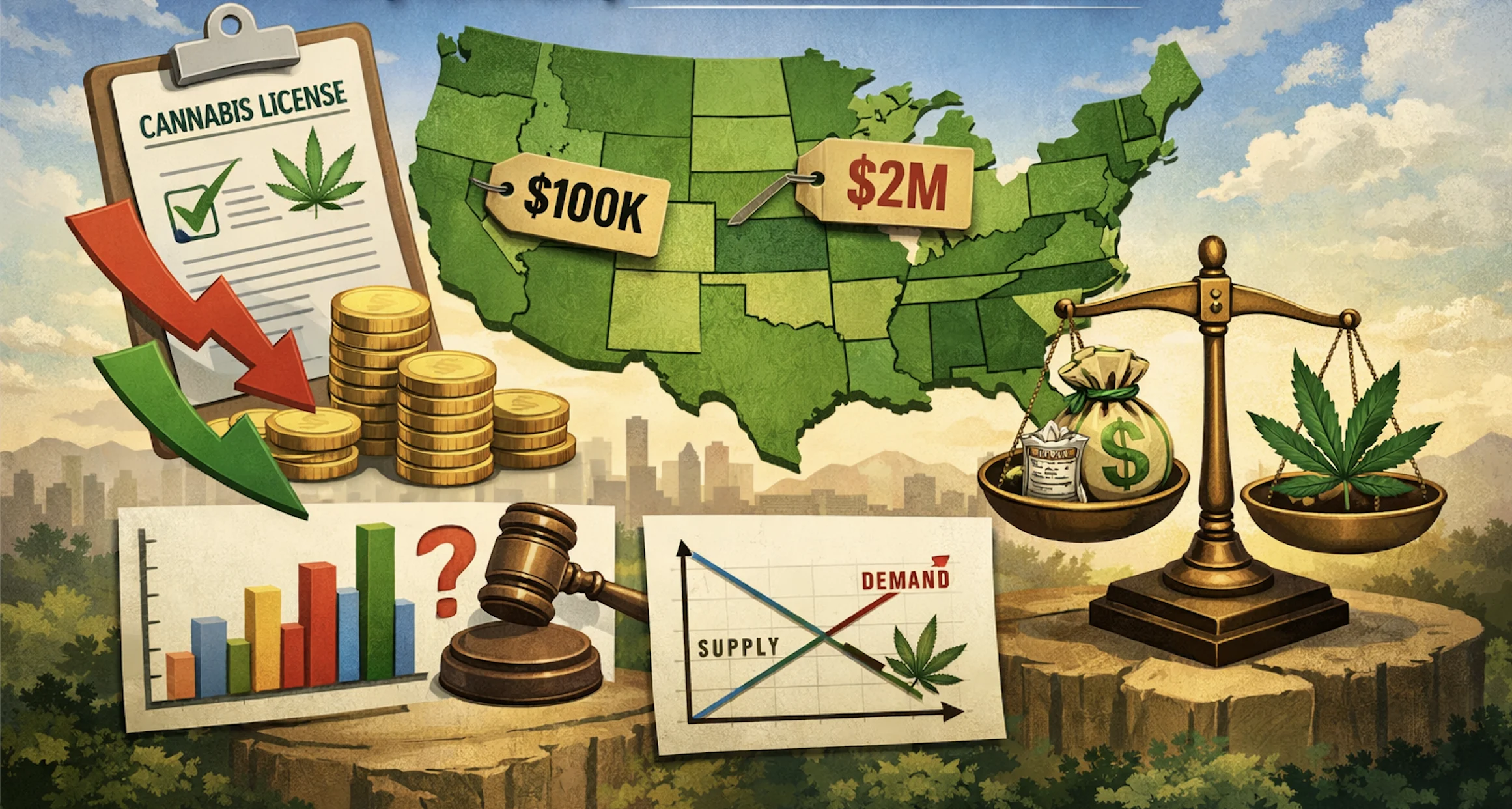
It Starts with One Reality: Cannabis Is a Supply-Constrained Industry
At its core, cannabis license value comes down to a basic principle:
Licenses are valuable because access is restricted.
In most states, regulators control supply through:
- License caps
- Zoning restrictions
- Application barriers
When supply is limited and demand is growing, values rise fast.
Industry data consistently shows that license scarcity is one of the most important drivers of value, with limited-license states commanding significantly higher premiums than saturated markets.
That’s why:
- States like Florida, Texas, and Illinois have historically seen high license valuations
- States like Oklahoma (with open licensing) have seen dramatically lower valuations
It’s not about the plant, it’s about access.
New Markets vs. Mature Markets
One of the clearest trends in cannabis right now:
New markets are worth more than mature ones.
In mature states like Colorado, Oregon, and California:
- There are more operators
- Pricing is competitive
- Margins are compressed
Meanwhile, newer markets:
- Have fewer licenses
- Less competition
- Higher growth expectations
As a result, licenses in emerging markets often command higher valuations than those in long-established states.
This is why investors often chase where the market is going, not where it’s already been.
License Structure: What Are You Actually Allowed to Do?
Not all licenses give you the same capabilities, and that matters more than most people think.
Most states award separate licenses for each activity in the supply chain, including:
- Cultivation
- Manufacturing
- Distribution
- Retail
Operators can usually obtain multiple license types to become a vertical operator, creating a fully controlled supply chain by owning multiple permits.
But in some states like Florida and Texas, the licenses themselves are vertical, meaning you can cultivate, process, and sell cannabis all under one license.
Vertical integration tends to drive higher values because:
- You control more of the margin
- You’re less reliant on third parties
- You can scale more efficiently
In fact, vertical models are often viewed as the most competitive structure in cannabis because they allow operators to manage costs and compete more effectively with illicit markets.
On the flip side, standalone licenses, especially cultivation and manufacturing, can become commoditized quickly.
And in some states, like Washington for example, vertical integration is expressly prohibited; if you buy a dispensary license in Washington state, you are not allowed to own a cultivation license.
Ownership Restrictions: Who’s Allowed to Buy?
This is one of the most underrated drivers of value.
Many states impose restrictions like:
- Residency requirements
- Ownership caps
- Social equity ownership thresholds
And here’s the key:
Every restriction reduces the number of potential buyers.
Fewer buyers = lower demand = lower valuation.
From a deal perspective, this is simple:
- Restricted ownership → limited buyer pool → valuations compress
- Open ownership → larger buyer pool → valuations rise
Transferability: Can the License Be Easily Sold?
This is where things get even more nuanced.
In some states, licenses are:
- Freely transferable (with approval)
- Slow to transfer (regulatory bottlenecks)
- Not transferable at all
That has a direct impact on value, because the harder it is to transfer the license, the fewer buyers will be interested. As stated above, a limited buyer pool compresses valuations.
The longer your buyer has to wait, and the more hoops they have to jump through, the more punitive they’ll be on price.
An easily transferrable license is a liquid asset, but a tough-to-transfer license carries regulatory risk.
Medical vs. Adult Use: The Biggest Value Catalyst
There’s one transition that consistently drives valuation spikes:
Medical → Adult Use Market Conversion
Why?
Because the total addressable market explodes overnight.
A medical-only market serves a limited patient base.An adult-use market serves everyone 21+, residents and tourists included.
But there’s nuance:
- If existing operators are grandfathered into adult use → massive upside
- If new licenses are issued → dilution risk
That’s why buyers often pay premiums in states that are likely to legalize adult use next; they’re pricing in future growth, not just current performance.
Competition and Saturation
Not all competition is created equal.
In limited-license markets:
- Fewer operators
- Higher margins
- Stronger valuations
In saturated markets:
- Price compression
- Lower margins
- Declining license values
There’s even evidence that in more competitive markets, license value can drop dramatically as supply increases, with underlying licenses contributing only a small portion of overall transaction value.
Local Regulations: Why City-Level Rules Matter
Cannabis is one of the only industries where local regulations can make or break asset value.
Even within the same state, value can vary based on:
- Zoning restrictions
- Store density limits
- Tax rates
- Buffer zones (distance between dispensaries and sensitive use parcels like schools, parks, churches, and other dispensaries)
Some cities allow only a handful of licenses, while others have no cap on the number of operators allowed.
That difference alone can create millions of dollars in value gap between two otherwise identical licenses.
Market Size and Growth Potential
Here’s where things get interesting:
License value isn’t based solely on the market dynamics today; value is tied to what the market could become.
Key factors include:
- Population size and growth
- Consumer adoption
- Tourism
- Future regulatory expansion
- Enforcement against illicit operators
Valuation professionals consistently emphasize that future earnings potential and market growth are core drivers of cannabis asset value.
That’s why a small current market can still command high valuations if the long-term upside is strong.
The Illicit Market Still Plays a Role
Even in legal states, the illicit market hasn’t disappeared.
In some markets, illegal growers and retailers still:
- Undercut pricing
- Reduce legal sales
- Impact operator margins
This creates a short-term drag on valuations, but over time that gap tends to close as legal infrastructure improves. As legal prices compress to be competitive with the illicit market, you see more consumers entering regulated channels.
So, What Actually Makes a License Valuable?
When you step back, the highest-value cannabis licenses tend to have a few things in common:
- Limited supply (license caps)
- Strong market growth potential
- Flexible or vertical license structures
- Minimal ownership restrictions
- Clear transferability
- Favorable local regulations
And the lowest-value licenses?
- Unlimited or oversupplied markets
- Heavy restrictions on ownership or transfer
- Prohibitions on vertical integration
- Exorbitant local sales or excise taxes
Final Thought
Cannabis license valuations depend primarily on regulation, scarcity, and future opportunity.
That’s what makes this industry unique.
It’s also what creates opportunity: because once you understand how these pieces fit together, you can start to see where value exists before everyone else does.