Sale-Leasebacks for Cannabis Operators: Pros, Cons, and When They Make Sense
Cannabis is one of the most real-estate-intensive industries in the country. Zoning approvals, specialized build-outs, and CUPs mean a compliant facility often represents years of work and a meaningful chunk of an operator’s balance sheet. The problem is that most of that value sits frozen inside the walls of the building instead of working in the business.
In 2026, with equity financing scarce and debt now dominating cannabis capital raises, more operators are taking a fresh look at one of the industry’s oldest real estate financing tools: the sale-leaseback. This guide breaks down how cannabis sale-leasebacks actually work, the real upside, the risks that operators should know, and how to think about whether one belongs in your capital stack.
What Is a Cannabis Sale-Leaseback, Exactly?
In a sale-leaseback, an operator sells the real estate it owns, a dispensary, cultivation facility, or processing plant, to an investor or specialized real estate company. At the same time, the operator signs a long-term lease for that same property and keeps running the business out of it. The operator goes from owner to tenant. The buyer is now their cannabis-friendly landlord.
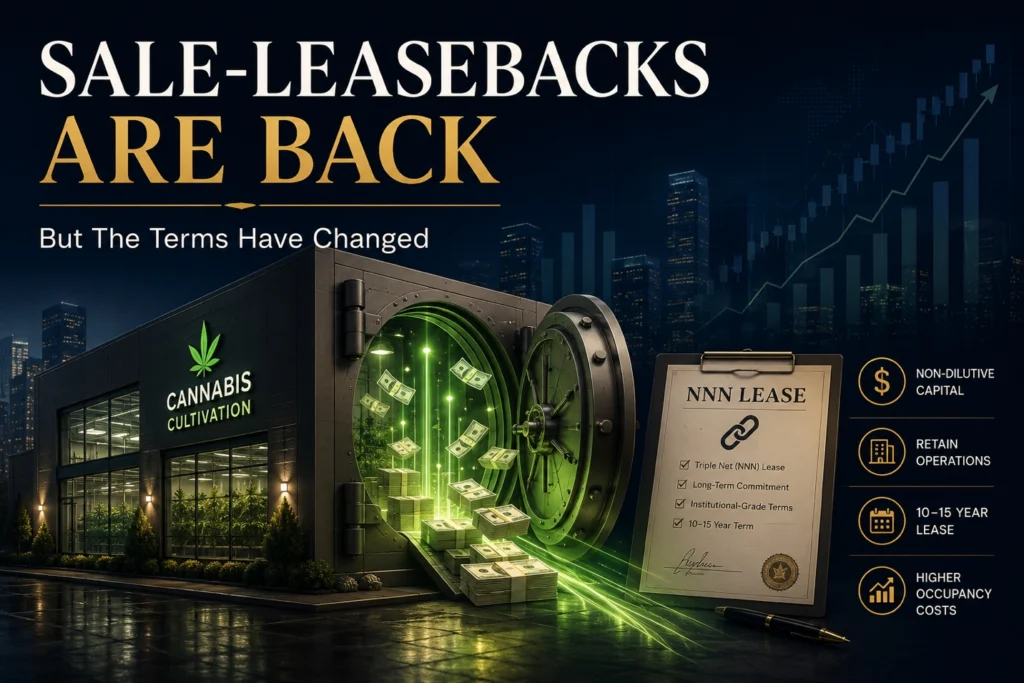
Most cannabis sale-leasebacks are structured as triple-net (NNN) leases, meaning the operator, as tenant, continues to pay property taxes, insurance, and maintenance on top of base rent. The operator keeps full control of day-to-day operations; only the ownership of the real estate changes hands.
Why Operators Use Them
Sale-leasebacks became popular in cannabis largely because federal illegality cut operators off from conventional bank financing. They filled a real gap, and the appeal still holds up for the right operator:
- Non-dilutive capital. No new equity is issued, so existing owners keep their stake.
- Unlocks trapped equity. A paid-off, fully built facility converts into cash without selling the operating business.
- Full operational control retained. The same team keeps running the same facility; only the ownership of the real estate changes.
- Funds growth without traditional debt. Proceeds can go toward new locations, working capital, paying down higher-cost debt, or a dividend recap to equity investors.
The Risks Operators Need to Underwrite
A sale-leaseback is not cheap capital, and it is not a refinancing. You are trading future rent obligations for cash today. A few specific risks deserve real attention before you sign an LOI:
- There is usually a real bid-ask spread on value. Sellers often want to be valued based on what they have invested in the building, or by applying a cap rate to above-market “cannabis” rent comps. Buyers, especially today, want to underwrite the property closer to non-cannabis sales comps so they carry less exposure if the tenant fails. That gap is one of the biggest reasons sale-leaseback negotiations drag on or fall apart, and it exists because most SLB groups are no longer paying the rich premiums they once did for cannabis real estate, largely a reaction to how high default rates have run across the industry.
- Long-term lock-in. Lease terms typically run well over a decade. That reduces your flexibility to relocate, downsize, or change footprint if your business or local market shifts.
- You give up the ability to refinance if rates improve. A sale-leaseback locks in a lease rate, usually with annual escalators, for 10 or more years. If cannabis-specific mortgage rates compress later in that term, you lose the ability to refinance the property at a lower cost. You are stuck paying the lease rate you agreed to today, even if financing conditions improve significantly down the road.
- It can hurt you when you eventually sell the business. Loading a facility with an expensive lease can work against you later. High fixed occupancy costs eat into EBITDA, which can reduce both how much a buyer is willing to pay and how many buyers are interested in the first place.
- The sector itself is under real stress in 2026. Legal industry analysts have flagged that sale-leaseback companies are facing significant financial pressure of their own, driven by oversupply, rising operator defaults, and higher interest rates squeezing the leveraged funds that bought these properties in the first place.
How Sale-Leaseback Valuations Actually Work
Sale-leaseback pricing is not based on replacement cost or how much an operator has invested in build-out. It is driven by lease economics and how buyers price default risk in a maturing, higher-risk industry:
- Dispensaries: Stabilized, well-located dispensaries typically trade at roughly 9–12%+ cap rates, depending on location, property value, tenant credit quality, and the strength of the lease.
- Industrial properties: Indoor cultivation facilities and processing or manufacturing buildings typically trade at higher cap rates, often in the 11–14%+ range, reflecting how specialized and harder to repurpose those buildings are.
- Alternative-use premium is capped. Most buyers will only pay roughly a 20–30% premium over non-cannabis market value for the real estate, even for industrial buildings with significant cannabis-specific improvements. That ceiling is exactly why the bid-ask spread described above happens so often: sellers anchored to replacement cost or above-market cannabis rent comps frequently expect more than buyers underwriting a non-cannabis exit value are willing to pay.
When a Sale-Leaseback Makes Sense
- The asset has meaningful embedded equity, so a sale-leaseback can genuinely convert that equity into working or expansion capital.
- Your business can comfortably support the monthly lease payment for the entire term, not just under today’s numbers.
- The property has real value to work with. As a practical matter, most dedicated sale-leaseback capital today will look at properties starting around $1 million or more.
- You have modeled this option side by side with your other capital choices, debt, mezzanine financing, or a minority equity raise, and the sale-leaseback still wins on net terms.
When It Doesn’t
- Your cash flow is early-stage or volatile. You won’t know what lease rate your business can support.
- There is already significant debt on the property, leaving little or no equity value left to unlock.
- There is cheap, existing debt on the property that would not make sense to replace with a comparatively higher lease cost.
- The resulting lease would put your occupancy costs above 15%. At that point, the fixed cost becomes a structural drag on the business rather than a financing solution.
- The property is too small. Sub-$1 million assets typically will not attract dedicated sale-leaseback capital on attractive terms.
- You think you may need to pivot, expand elsewhere, or exit the location within the lease term.
The Bottom Line
Sale-leasebacks remain one of the more effective ways for a cannabis operator to convert real estate equity into working capital without giving up ownership of the business or day-to-day control. But 2026 has made clear that the structure carries real risk on both sides of the table, not just for the operator signing the lease, but for the buyers underwriting it amid a wave of industry defaults. The operators getting the best outcomes are treating sale-leasebacks the way they would treat any other financing decision: comparing it against real alternatives, pricing the property realistically against where the market actually trades, and modeling the lease obligation all the way through a future sale of the business.
If you are evaluating a sale-leaseback, listing real estate outright, or just want to benchmark your facility against current market comps, CannaMLS gives you the listing data and the marketplace to make an informed decision. Browse the catalog or contact a CannaMLS PRO today.
Sources
- Blank Rome / National Law Review – Distressed Cannabis Sale-Leaseback Companies: What Investors and Operators Need to Know (March 2026)
- 420 Property – Sale-Leasebacks in Cannabis: Valuations, Yields, Risks
- Cannabis Business Times – How a Sale-Leaseback Acquisition Works
- MJBizDaily – Marijuana Businesses Raise Millions of Dollars Through Sale-Leaseback Deals
- MJBizDaily – Debt Dominates Cannabis Capital Raises as Equity Deals Slow