The Turnkey Advantage: Why Cannabis Operators Are Buying Instead of Building
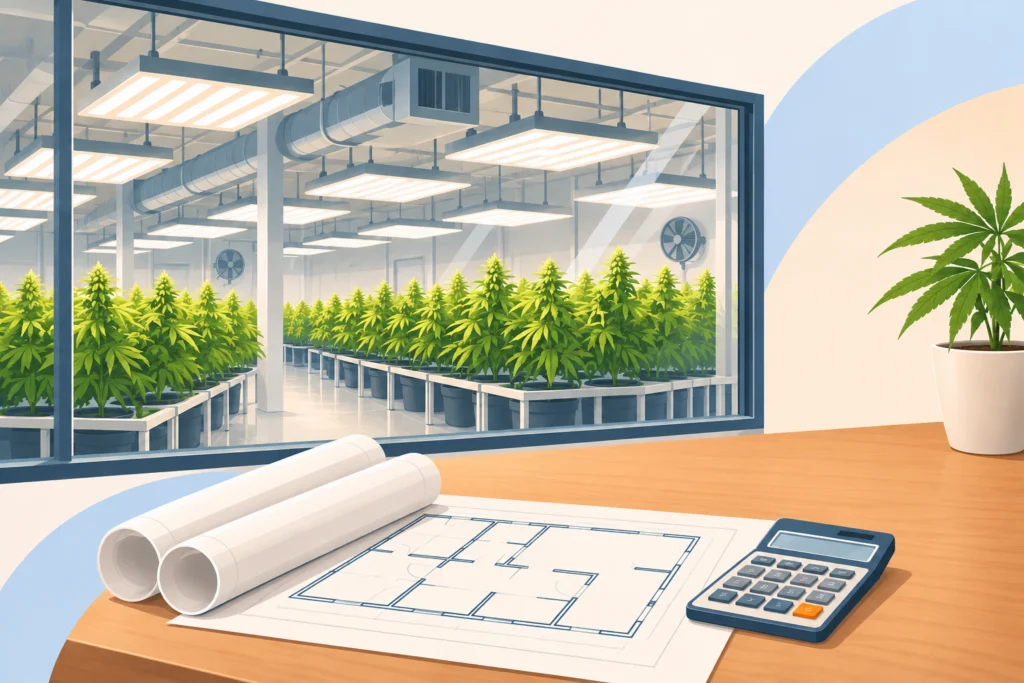
Five years ago, cannabis operators were spending tens of millions of dollars building state-of-the-art cultivation and manufacturing facilities. Capital was relatively accessible, wholesale pricing supported aggressive revenue projections, and operators were racing to establish market share.
Fast forward to 2026, and many of those same facilities are available for a fraction of what they originally cost to build.
Some are operational. Some are sitting vacant. Others are being sold through receiverships, lender workouts, or corporate restructuring efforts.
Meanwhile, building a new cannabis facility remains expensive, utility upgrades can take well over a year, and cannabis financing continues to come at a premium. This creates an interesting opportunity for well-capitalized buyers.
Why spend $20 million and two years building a facility when you may be able to acquire comparable infrastructure for $12 million and be operational in a matter of months?
The opportunity is not just in buying distressed assets. It is in buying infrastructure, time, and regulatory approvals at a discount to what it would cost to recreate them.
The Disconnect Between Replacement Cost and Market Value
Cannabis real estate is among the most expensive specialty commercial real estate to develop. An indoor cultivation facility requires substantial investment in systems that traditional industrial buildings simply do not have:
- High-capacity electrical infrastructure and distribution
- Specialized HVAC and dehumidification systems
- Commercial cultivation lighting
- Automated irrigation and fertigation systems
- Environmental monitoring and controls
- Water treatment and wastewater infrastructure
- Regulatory-compliant security systems
During the last expansion cycle, operators invested heavily in these systems based on revenue projections that assumed stronger wholesale pricing, limited competition, and continued market growth.
In many states, those assumptions did not hold.
The result is a growing disconnect between what cannabis infrastructure costs to build and what buyers are willing to pay for it today.
For the next generation of cannabis operators, this creates an opportunity to enter the industry with a fundamentally different cost basis than their predecessors.
An operator acquiring a facility for at a substantial discount to its replacement cost has a structural advantage over a competitor still servicing debt from a $20 million development, assuming both facilities can deliver comparable operational performance.
That advantage extends well beyond the initial purchase price.
The Economics of Buying vs. Building
Consider an illustrative example of an operator looking to establish a 50,000-square-foot indoor cultivation facility.
| Investment Criteria | Ground-Up Development | Turnkey Acquisition |
|---|---|---|
| Development or acquisition cost | $20,000,000 | $12,000,000 |
| Additional capital improvements | Included | $1,000,000 |
| Total project cost | $20,000,000 | $13,000,000 |
| Cost per square foot | $400 | $260 |
| Debt financing (60% LTC) | $12,000,000 | $7,800,000 |
| Required equity | $8,000,000 | $5,200,000 |
| Assumed interest rate | 13% | 13% |
| Annual interest at full funding | $1,560,000 | $1,014,000 |
| Estimated time to operations | 24 months | 6 months |
Illustrative underwriting scenario. Actual costs, financing terms, regulatory timelines, construction draw schedules, and working capital requirements will vary by project.
In this scenario, the operator acquiring the existing facility benefits from:
- $7 million less in upfront project costs
- $2.8 million less in required equity
- $546,000 less in annual interest expense at full funding
- An estimated 18-month head start on operations
Assuming comparable operating performance, the acquisition requires 35% less project capital to generate the same earnings.
That translates into a potentially higher return on invested capital, a lower cash flow breakeven point, and greater flexibility to withstand market volatility.
It also leaves more capital available for the things that actually drive revenue: people, product quality, brand development, inventory, and distribution.
Speed to Market: The Hidden Cost of Building
One of the most underestimated costs in cannabis development is time.
Every month spent securing permits, waiting on equipment, completing construction, or navigating utility approvals is another month that capital is committed to a project without generating revenue.
Electrical infrastructure is a particularly significant concern for indoor cultivation.
In a March 2026 webinar, the U.S. Department of Energy reported that distribution transformer lead times increased from 3 - 6 months in 2019 to 1 - 2 years or longer in 2024, the latest year of data referenced in the presentation.
Growing electricity demand from data centers, manufacturing, and other industrial users is adding further competition for grid capacity and equipment.
For cannabis operators, securing a building is one thing. Securing enough power to operate that building is another.
A second-generation cannabis facility with established electrical service, sufficient mechanical capacity, and existing entitlements can eliminate some of the most unpredictable elements of development.
However, buyers should independently verify that the existing utility capacity remains available and is sufficient for their intended operations. Installed equipment and approved electrical capacity are not necessarily the same thing as active, available power.
The Cost of Capital Reinforces the Turnkey Advantage
Cannabis financing remains expensive relative to traditional commercial real estate financing.
In its third-quarter 2026 investor presentation filed with the SEC, cannabis-focused lender Chicago Atlantic Real Estate Finance reported a weighted average portfolio yield-to-maturity IRR of 14.8%, including its Koach note investments.
While lender portfolio yields are not directly equivalent to borrower interest rates, they illustrate the relatively high cost of capital that continues to characterize cannabis lending.
At these financing costs, the difference between buying and building becomes even more meaningful.
Ground-up development requires operators to carry debt through permitting, construction, inspections, and operational ramp-up. Interest expense accumulates long before the facility generates revenue.
An existing operational facility, by comparison, allows lenders to evaluate historical financial performance, production metrics, collateral quality, and debt service coverage. A vacant turnkey facility may also present financing advantages if the buyer has a credible operating plan and sufficient working capital.
In today's market, minimizing the amount of capital required to become operational can be just as important as maximizing projected revenue.
Where Is the Turnkey Opportunity Most Compelling?
Cannabis is not one national market. The economics of buying versus building vary considerably by state, and the reasons to pursue an acquisition in Michigan may be very different from the reasons to pursue one in Ohio.
Michigan and Colorado: Buying at a Discount
Mature markets like Michigan and Colorado illustrate how wholesale price compression can fundamentally change the value of cultivation infrastructure.
The Michigan Department of Treasury's third-quarter 2026 wholesale price guidance established an estimated wholesale flower price of approximately $641 per pound for tax calculation purposes.
In Colorado, similar pricing pressure has contributed to substantial operators reevaluating their cultivation footprints.
In August 2026, MJBizDaily reported that Native Roots was closing its Denver cultivation facility following the acquisition of its retail stores. This followed cultivation closures involving PharmaCann and The Cannabist Company.
These developments create potential opportunities for efficient operators to acquire existing infrastructure at attractive prices.
But they also highlight an important question: if established operators are finding it more economical to purchase wholesale flower than produce it themselves, does acquiring another cultivation facility actually make sense?
A discounted acquisition price only works if the operating economics support it.
Massachusetts: Opportunities in a Maturing Market
Massachusetts offers another interesting dynamic. Consumer demand remains substantial, but operators are competing in an increasingly mature market.
In September 2026, the Massachusetts Cannabis Control Commission announced that the state's adult-use cannabis market had surpassed $10 billion in cumulative sales.
Strong statewide sales, however, do not necessarily translate into strong margins for every individual operator.
For buyers evaluating Massachusetts, acquiring existing infrastructure at a favorable cost basis may provide a competitive advantage over operators still carrying the financial obligations associated with early market development.
Ohio and New Jersey: Buying Time
In newer adult-use markets, the opportunity is not always about acquiring distressed infrastructure. It is often about getting operational faster.
According to the Ohio Division of Cannabis Control's October 2026 market update, Ohio had nearly $2 billion in cumulative non-medical cannabis sales since adult-use sales began in August 2024.
New Jersey also continues to demonstrate substantial consumer demand. The New Jersey Cannabis Regulatory Commission's July 2026 market presentation reported a 22.8% year-over-year increase in estimated adult-use sales for June 2026.
In markets like these, where consumer demand and the competitive landscape continue to evolve, getting operational 6 - 12 months earlier can be particularly valuable. The distinction is important: in mature markets, the opportunity is often in the acquisition price; in developing markets, the opportunity is often in the time saved.
Distressed Assets Are Creating a New Entry Point
The cannabis industry's restructuring cycle is creating opportunities that were largely unavailable during the initial expansion years.
Operators facing liquidity constraints, debt maturities, or strategic repositioning are selling facilities that previously required substantial capital to develop.
In October 2026, MJBizDaily reported that Spherex acquired two Colorado cultivation facilities from The Cannabist Company, including an indoor facility in Denver and an outdoor cultivation operation in Trinidad.
Transactions like this illustrate how existing cannabis infrastructure can find new ownership without requiring additional ground-up development.
Buyers evaluating distressed opportunities should pay particular attention to:
- Outstanding liens and secured creditor interests
- Unpaid taxes and regulatory obligations
- Ownership of installed equipment and FF&E
- License status and transferability
- Deferred maintenance and environmental exposure
- Court approvals and the scope of liabilities being transferred
A receivership or lender-driven sale can present attractive acquisition economics, but buyers should never assume that purchasing through a distressed transaction automatically eliminates all historical liabilities.
The transaction structure matters just as much as the purchase price.
When Buying Below Replacement Cost Isn't a Good Deal
A facility that cost $20 million to build and is now available for $5 million is not automatically worth $5 million.
Replacement cost is only relevant if the infrastructure you are acquiring actually supports your intended business model.
Some of the biggest risks buyers should evaluate include:
- Outdated lighting and energy-intensive equipment
- Inefficient facility layouts that increase labor costs
- Undersized HVAC and dehumidification systems
- Deferred maintenance and costly mechanical replacements
- Expired licenses or conditional use permits
- Excess production capacity relative to local market demand
A cultivation facility may have been designed around wholesale flower pricing of $2,000 per pound. If that same market now supports pricing closer to $600 per pound, the original design and operating cost structure may no longer make sense.
In some cases, building a smaller, more efficient facility may generate a better long-term return than acquiring an oversized legacy operation at a substantial discount.
The goal is not to buy someone else's capital expenditure at a discount. The goal is to acquire infrastructure that allows you to operate profitably in today's market.
What This Means for Owners Looking to Sell
If you own an existing cannabis facility, the current market creates an opportunity to position your asset differently.
Rather than focusing exclusively on how much you originally invested, demonstrate how much money and time a buyer could save by acquiring your facility instead of building their own.
Quantify the advantages:
- Current electrical service and available power capacity
- Estimated replacement cost of functional mechanical systems
- Existing zoning, entitlements, and regulatory approvals
- Operational production capacity and historical performance
- Estimated capital investment required to resume or expand operations
Sophisticated buyers are not going to reimburse you for historical capital expenditures simply because you made them. They will, however, pay for infrastructure that reduces their future capital requirements, accelerates their timeline, and supports a profitable operation.
Make those advantages easy to underwrite.
Final Thoughts
One of the most interesting opportunities in cannabis today is the disconnect between what infrastructure costs to build and what that same infrastructure can be acquired for in the secondary market.
The previous generation of cannabis operators invested heavily in developing facilities, securing entitlements, upgrading utilities, and building production capacity. The next generation has an opportunity to leverage that investment at a fundamentally different cost basis.
Less capital invested. Less debt to service. Less time spent waiting to generate revenue.
But the discount alone is not the investment thesis. The real opportunity is acquiring the right infrastructure, in the right market, at a price that supports sustainable operations.
If you are considering entering a new cannabis market or expanding your existing footprint in 2027, spend some time evaluating the secondary market before committing capital to a new development.
Browse the CannaMLS Listing Catalog to explore existing cannabis licenses, turnkey facilities, and cannabis real estate opportunities nationwide, or contact a CannaMLS PRO for assistance identifying and evaluating acquisition opportunities.