June 2026 Newsletter
DEA Hearing Begins: Could Adult-Use Cannabis Be Next for 280E Relief?
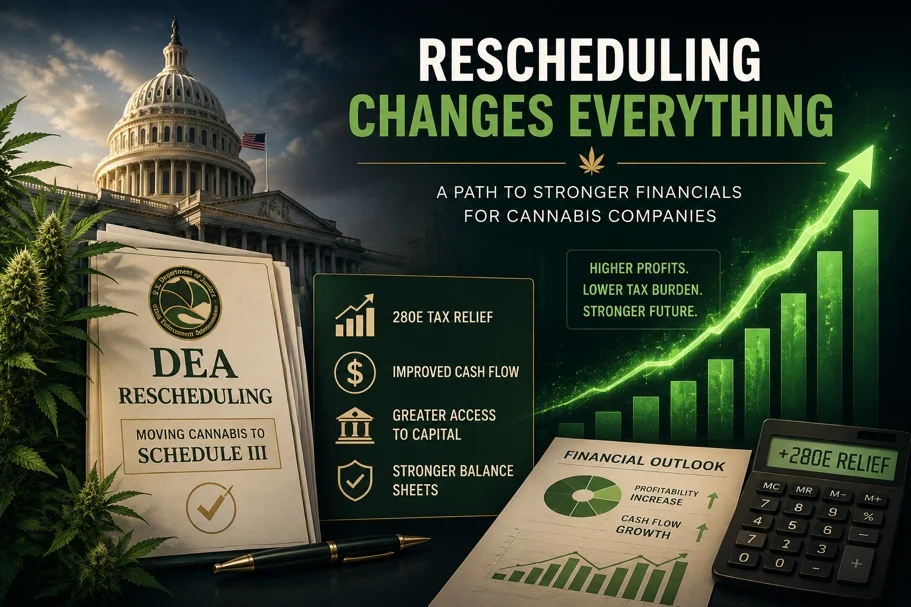
Federal cannabis policy reaches a new milestone this month. On June 29, the DEA opened a formal administrative hearing in Arlington, Virginia to decide whether the all cannabis, including adult-use cannabis, should move from Schedule I to Schedule III of the Controlled Substances Act. The hearing is expected to run through July 15.
This is a narrower question than it might sound. State-licensed medical cannabis and FDA-approved cannabis products were already moved to Schedule III back in April, under a final order from the Acting Attorney General. That immediate, narrower action is done. What the hearing will determine is whether the rest of the industry, aka the adult-use market that makes up the bulk of state-licensed sales, follows the same path. An administrative law judge will hear evidence from designated parties and issue a non-binding recommendation; final authority rests with the DEA Administrator, with most observers expecting a decision by fall 2026.
The stakes are real money. Section 280E, the tax provision that has historically blocked cannabis businesses from deducting ordinary expenses like rent, payroll, and marketing, no longer applies to state-licensed medical operators as of this spring, a change some estimate freed up more than $2 billion in industry-wide cash flow. If the June hearing leads to full rescheduling, that same relief could extend to adult-use operators, whose effective federal tax rates have run as high as 70-90%. Industry analysts peg the value of that broader relief in the high single-digit billions annually.
Sale-Leasebacks Have Returned, but the Terms Have Changed
Cannabis is one of the most real estate-intensive industries in the country. Zoning approvals, specialized build-outs, and conditional use permits mean a compliant facility often represents years of work, and a meaningful share of an operator's balance sheet. The problem is that most of that value sits frozen inside the walls of the building instead of working in the business.
In 2026, with equity financing scarce and debt now dominating cannabis capital raises, more operators are taking a fresh look at one of the industry's oldest real estate financing tools: the sale-leaseback. Done at the right price, it can convert a paid-off facility into working capital without giving up ownership of the business. Done at the wrong price or the wrong time, it can lock an operator into a decade-plus of rent that erodes margins and limits flexibility. In our latest blog post, we break down:
- how cannabis sale-leasebacks work, and why operators turn to them
- the risks to underwrite, including valuation bid-ask spreads and the financial stress now hitting sale-leaseback buyers themselves
- where dispensary and industrial cap rates are trading right now
- a clear framework for when a sale-leaseback makes sense, and when it doesn't
Read the blog for a full breakdown of how sale-leaseback economics are shifting in 2026, and whether one belongs in your capital stack.
California Approves Dual Licensing to Help Operators Capture 280E Relief
California's Department of Cannabis Control has adopted emergency regulations letting licensees split a combined adult-use/medicinal license into two separate licenses, so the roughly 1,600 eligible operators can cleanly claim federal 280E tax deductions on their medical-designated business now that medical cannabis sits in Schedule III.
California is one of several states moving quickly to help operators capture the federal relief finally available to them, even if adult-use rescheduling later this year makes the bifurcation unnecessary.
Connecticut Cannabis Sales Climb Past $120 Million as Prices Stabilize
Connecticut's cannabis sales climbed for a third straight month in May, with licensed retailers selling just over $25 million and pushing the state's 2026 total above $120 million. Prices ticked up slightly to $7.18 per gram after hitting an all-time low in April, but remain down about 24% year-over-year, a sign the market may be settling into maturity rather than distress.
For operators and investors, rising volume alongside stabilizing prices points to a market where efficiency and scale matter most. Expect continued interest in consolidation among Connecticut operators competing on cost against cheaper product just across the border.
Illinois Enacts Sweeping Cannabis and Hemp Reforms
Illinois just enacted one of its biggest cannabis overhauls yet. Governor JB Pritzker signed SB 3222 on June 12, restricting intoxicating hemp products to licensed dispensaries starting November 12, legalizing drive-through and curbside dispensary service, extending hours to 2 a.m., and nearly tripling craft grower canopy limits from 5,000 to 14,000 square feet.
For CannaMLS users, that means real estate opportunity on multiple fronts: dispensaries retrofitting for drive-through lanes, craft growers needing larger cultivation space, and a wave of former hemp retail locations that could convert into licensed dispensaries once the November deadline hits.