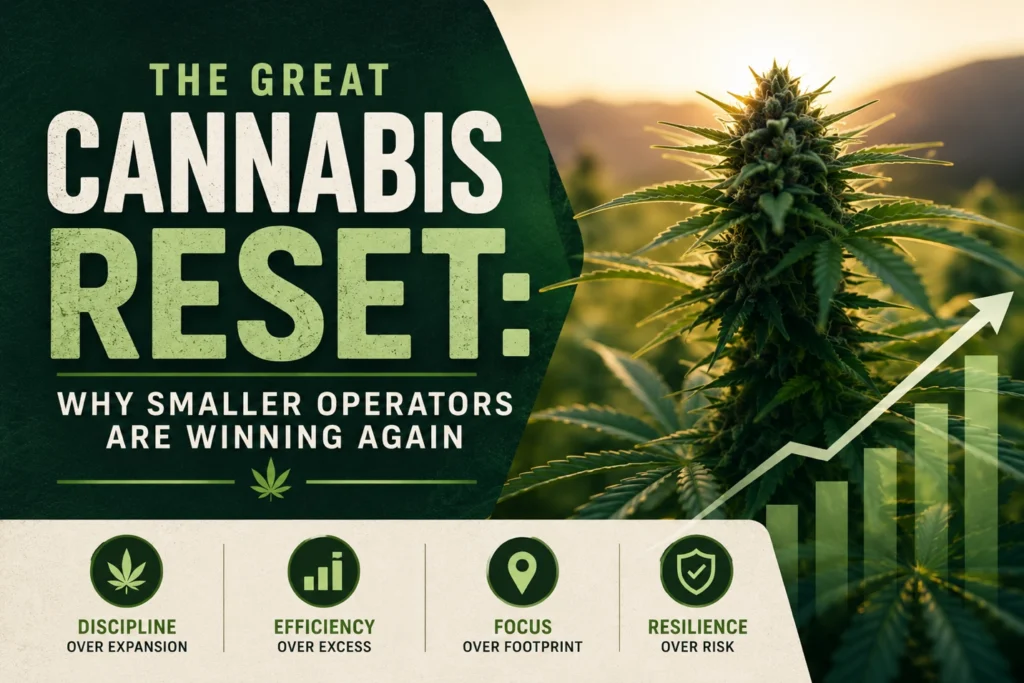
The Great Cannabis Reset: Why Smaller Operators Are Winning Again
For most of the last decade, the cannabis industry rewarded aggressive expansion.
- Raise more capital.
- Open more stores.
- Build more canopy.
- Enter more states
Growth itself became the strategy.
The largest operators raced to establish national footprints while investors rewarded scale, revenue growth, and total addressable market above almost everything else. Operators assumed continued pricing strength, expanding consumer demand, and easier access to capital would eventually solve operational inefficiencies. That mentality no longer exists.
In 2026, the cannabis industry is entering a different phase; one defined less by expansion and more by discipline. Across the country, many of the operators quietly performing best today are not the biggest companies with the largest footprints. They are leaner, more focused businesses with tighter operations, lower overhead, and a stronger understanding of their local markets.
The industry is resetting.
And in many cases, smaller operators are winning again.
The Growth-at-All-Costs Era Is Colliding with Reality
Cannabis companies spent years operating in an environment where growth often mattered more than profitability. Cheap equity capital, optimistic projections, and rapid legalization encouraged operators to scale aggressively.
But several pressures are now forcing the industry to recalibrate:
- continued 280E tax burdens for adult-use operators
- expensive debt markets
- declining wholesale pricing
- increased competition
- margin compression
- oversupply in mature states
- rising operating costs
At the same time, a significant amount of cannabis debt is now approaching maturity. Multiple industry analysts estimate billions of dollars of cannabis debt will mature by the end of 2026, creating refinancing pressure across the sector.
For many operators, especially heavily leveraged multi-state operators (“MSOs”), the priority has shifted from expansion toward:
- preserving cash flow
- refinancing debt
- rationalizing footprints
- reducing overhead
- selling non-core assets
That shift is changing the competitive landscape.
Bigger Is No Longer Automatically Better
Scale still matters in cannabis. Large operators have clear advantages in procurement, branding, compliance infrastructure, and access to capital. But scale also creates complexity.
Large footprints often come with:
- expensive legacy leases
- oversized cultivation facilities
- bloated corporate overhead
- operational inefficiencies
- slower decision-making
- integration challenges across multiple states
In contrast, many smaller operators built their businesses differently. Instead of trying to dominate multiple markets simultaneously, they focused on:
- operational efficiency
- local market positioning
- disciplined capex
- manageable growth
- tighter inventory controls
- customer retention
That discipline matters far more in today’s market than it did during the early expansion phase of the industry. The cannabis market is finally rewarding operators that know how to survive difficult environments, not just operators that know how to raise money.
Missouri Shows What a Healthy Limited-License Market Can Look Like
Missouri remains one of the strongest examples of a market where smaller operators can still compete effectively.
The state’s regulated structure, combined with relatively limited license supply, has helped support healthier pricing and more sustainable operations than many oversupplied western markets. Missouri cannabis sales reached approximately $1.5 billion in 2025 and continue to show year-over-year growth in 2026.
Importantly, many successful Missouri operators are not massive public companies. They are:
- disciplined regional operators
- independent retailers
- focused cultivation teams
- vertically integrated local businesses
In many cases, these operators benefit from:
- stronger local brand identity
- lower overhead
- faster operational decision-making
- better alignment between ownership and management
Missouri is not without its own structural challenges. Large vertically integrated operators control a meaningful share of the retail market and have faced scrutiny from competitors regarding market concentration. However, unlike some mature markets dominated almost entirely by national MSOs, Missouri still supports a notable ecosystem of independent and locally owned operators that continue to grow and compete successfully statewide.
Markets like Missouri demonstrate that cannabis businesses do not necessarily need enormous national footprints to build valuable operations.
Michigan Illustrates the Other Side of the Equation
Michigan tells a very different story.
The state’s highly competitive environment and continued oversupply have created severe price compression across the market. Retail cannabis prices have fallen dramatically, while many operators struggle to maintain margins despite continued consumer demand.
Michigan operators are now dealing with declining wholesale prices, store closures, oversupply, increased taxation, and shrinking margins. The average retail price for cannabis flower in Michigan fell to approximately $58 per ounce by late 2025 according to state-reported data.
In markets like this, operational efficiency becomes everything. Smaller operators with lean staffing, efficient cultivation, strong local customer bases, and lower debt burdens often have greater flexibility to survive pricing pressure than larger operators carrying heavier infrastructure and corporate expenses.
The result is a market where disciplined execution increasingly matters more than sheer scale.
Developing Markets Reward Focused Operators
Emerging East Coast markets continue to create opportunities for smaller, focused businesses.
New Jersey’s cannabis market continues expanding, with hundreds of licenses now operational or moving toward activation. But unlike earlier “land grab” markets, many operators entering New Jersey today are being forced to think more carefully about:
- store economics
- municipality selection
- operational efficiency
- customer retention
- real estate quality
- long-term profitability
The operators succeeding in these markets are often highly selective about:
- where they open
- how much they spend
- how quickly they expand
That is a major departure from the earlier cannabis expansion cycle.
Maryland, Ohio, and other developing markets are showing similar trends. Operators that maintain disciplined growth strategies and realistic capital structures are increasingly viewed as more attractive businesses than operators attempting rapid expansion without stable underlying economics.
Capital Markets Are Also Driving the Reset
The financing environment itself is reinforcing this shift.
Cannabis debt financing now dominates capital raising activity, while traditional equity financing remains constrained. Recent industry data indicates debt accounted for nearly 95% of capital raised by U.S. cannabis operators in 2025.
At the same time:
- lenders are underwriting more conservatively
- investors are prioritizing profitability over projections
- buyers are focusing more heavily on operational quality
- distressed assets continue entering the market
This creates a much different environment than the cannabis industry experienced during the earlier “green rush.”
Today, investors are often more interested in stable EBITDA, disciplined management, defensible market positions, efficient operations, and realistic growth plans than large-but-unprofitable expansion stories.
The Industry Is Becoming More Operationally Sophisticated
This reset may ultimately strengthen the industry.
For years, cannabis valuations often prioritized future opportunity over operational fundamentals. Today, the market is becoming more disciplined and more institutional in how it evaluates businesses.
Buyers increasingly focus on cash flow quality, infrastructure durability, local market dynamics, tax exposure, and operational efficiency. That evolution favors operators that built sustainable businesses rather than speculative growth platforms.
Final Thought
The cannabis industry is not disappearing. It is maturing.
The “growth-at-all-costs” phase that defined much of the last decade is giving way to something more operationally grounded. Markets are becoming more competitive, capital is becoming more selective, and buyers are becoming more sophisticated.
In this environment, efficiency matters. Discipline matters. Local execution matters.
And increasingly, many of the operators best positioned for the next phase of the industry are not necessarily the biggest ones.
They are the operators that learned how to build durable businesses while everyone else was chasing scale.
Sources:
Cannabiz Media – Cannabis Industry Debt Pressures & Refinancing Challenges
MJBizDaily – Missouri Cannabis Sales Hit Record $1.5 Billion in 2025
MJBizDaily – Michigan Cannabis Sales Hit Record High While Revenue Declines Due to Price Compression
New Jersey Cannabis Regulatory Commission – February 2026 Market Update & Licensing Data
MJBizDaily – Debt Dominates Cannabis Capital Raises as Equity Deals Slow